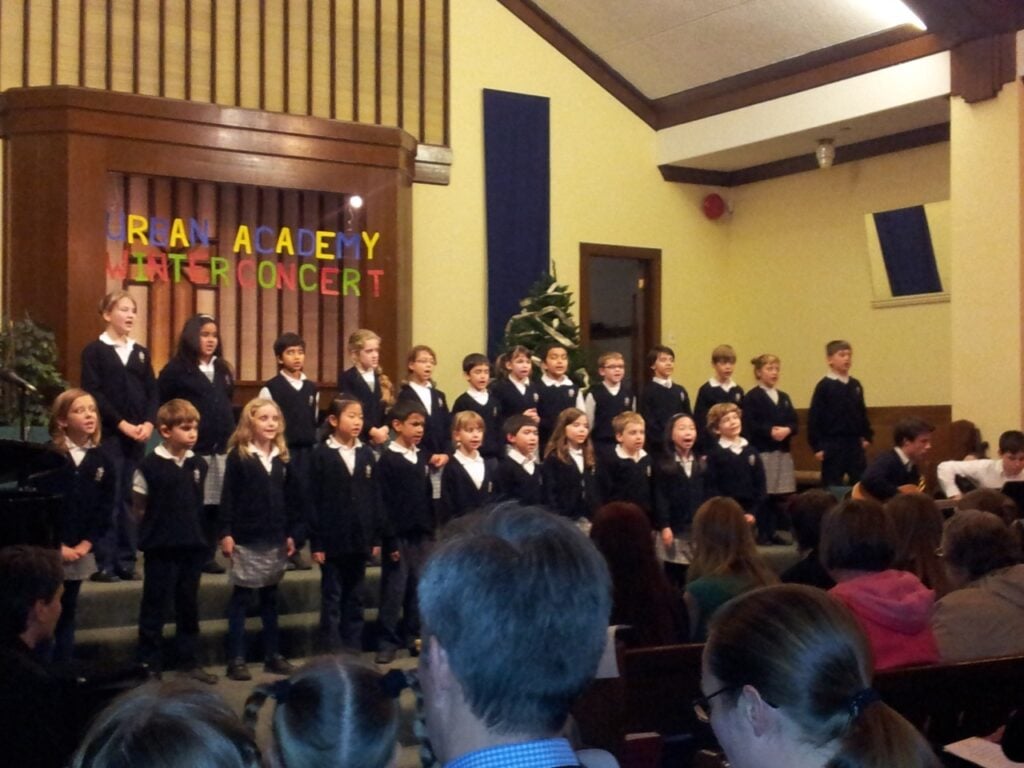


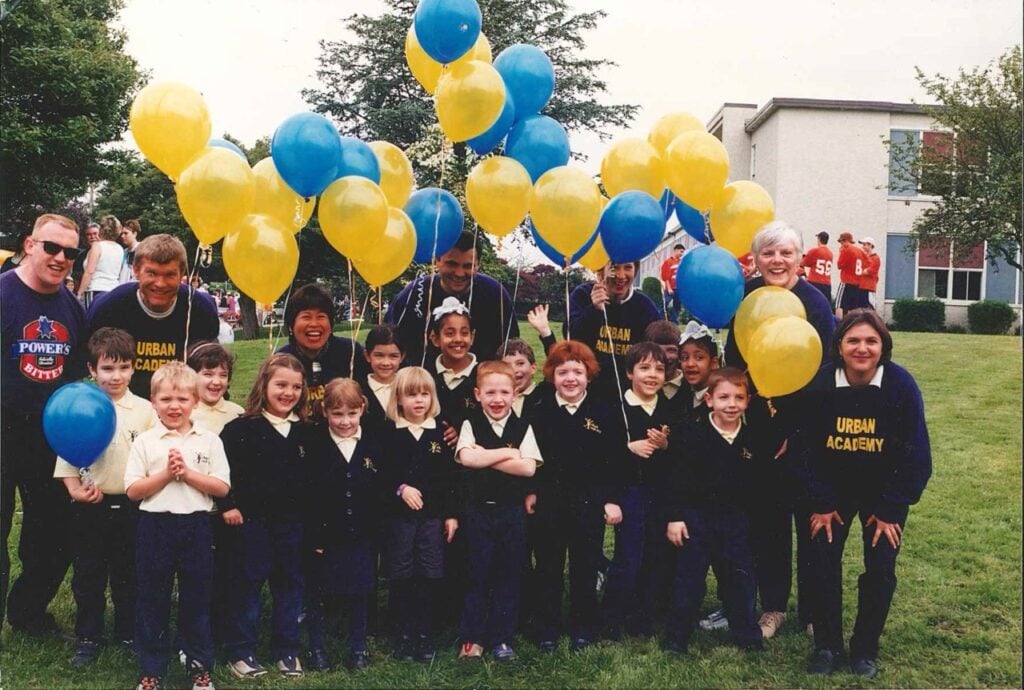
On the 25th anniversary of Urban Academy, its founders—Donna Tays, Brian and Laura Drummond—gathered overlooking the Fraser River in the New Westminster Boathouse to reminisce and share stories of the school’s beginning. Amidst laughter and a few tears, they sifted through a binder of old newspaper clippings and photos, and reflected on their journey of building a school from the ground up. It is a story they described as involving “a lot of manual labour, a church basement, countless late nights and a dream.”
The journey began when Brian and Laura Drummond’s son, Aidan, the oldest of their three children, was nearing school age. Uninspired by the public school system, they started researching and found that their friends’ children at private schools in Vancouver were learning the arts, music, languages, and so many other things that were missing from the local options.
Donna Tays recalled her own experience as a young teacher: “I was young, keen and trying new things in the classroom, but was told not to rock the boat. I said to myself, ‘honest to goodness, there’s such a better way to teach children than what we were doing as standard practice.’” So with the desire to see her own two kids (who were still a bit younger than school age) not just survive, but thrive, she started to think about what might be possible.
The Drummonds had recently met Donna Tays and her husband, Glen Clarke, at a personal development course. One evening, the Drummonds filled their living room with friends who had young children, and Donna was on that invite list. That fateful evening, they welcomed a teacher who they had heard was doing wonderful things in Vancouver, to share what she was up to, hoping to bring to New Westminster. Though that plan never materialized, the seed was planted. Brian remembers thinking, “All we need is a teacher and a space, so why don’t we do this ourselves?” It turned out that all three founders shared a vision for a place with a strong focus on arts, music, drama, and French from the earliest grades, a place where the curriculum would be rich and the children would be inspired.
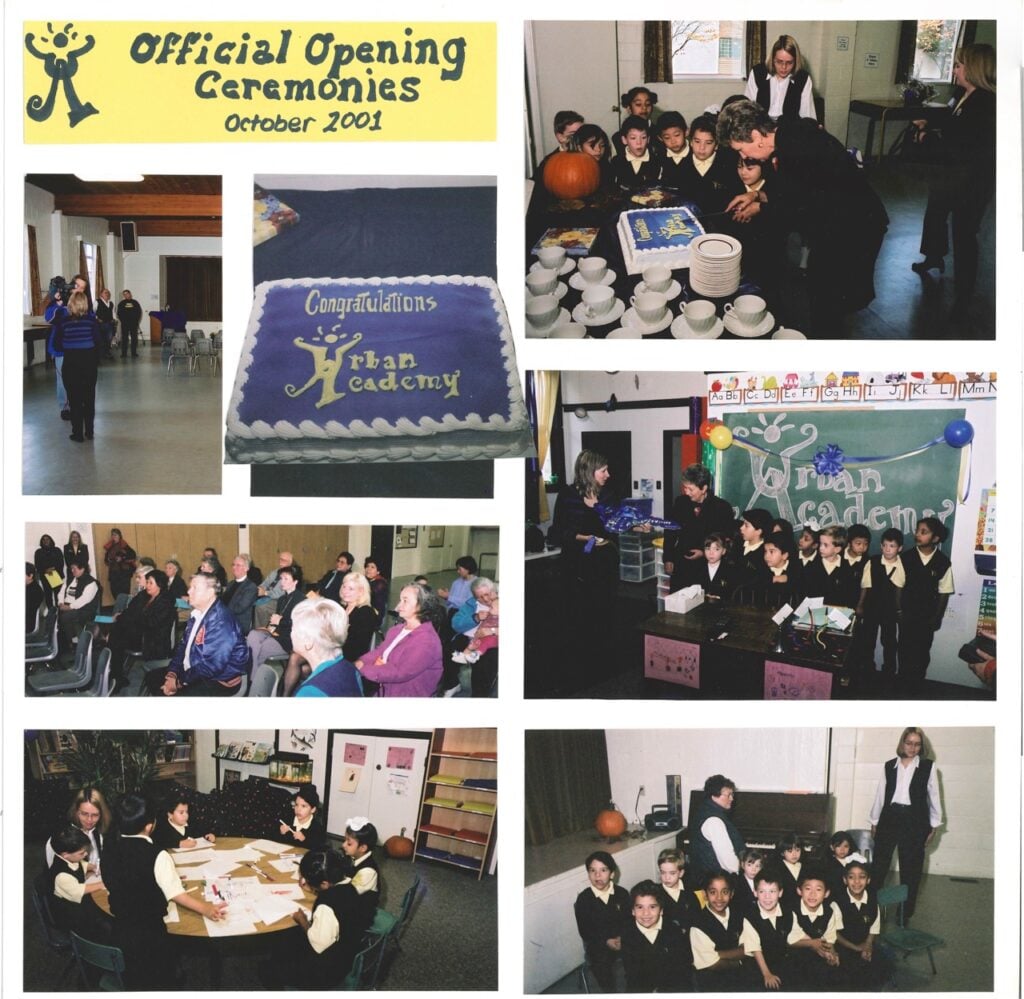
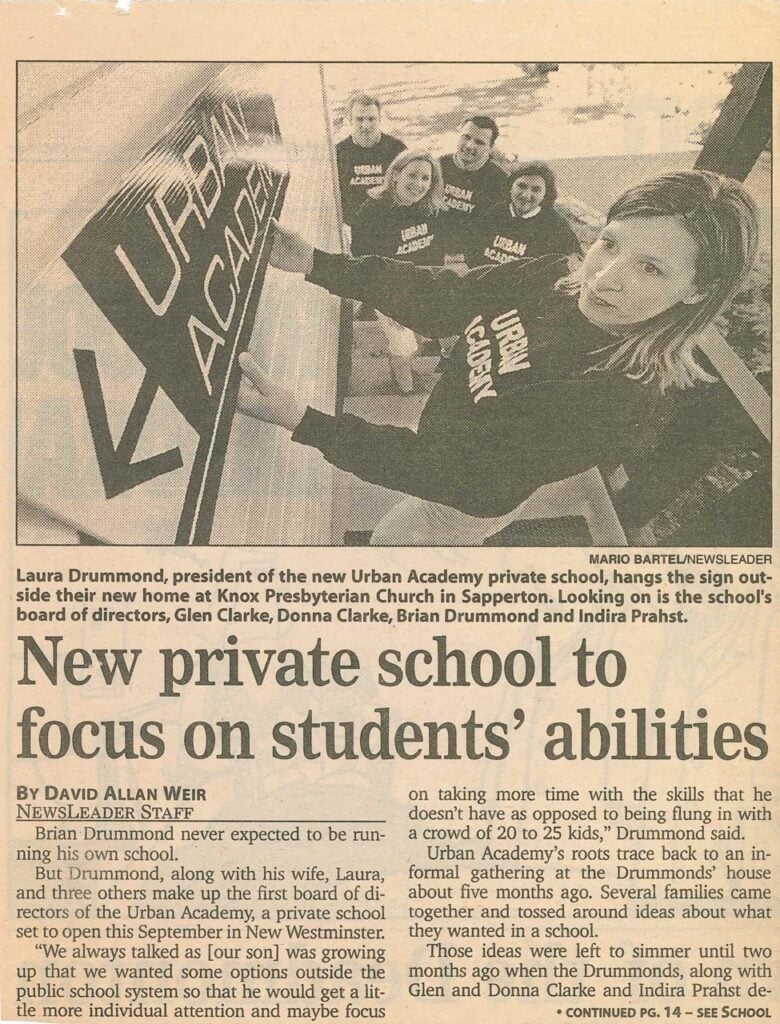
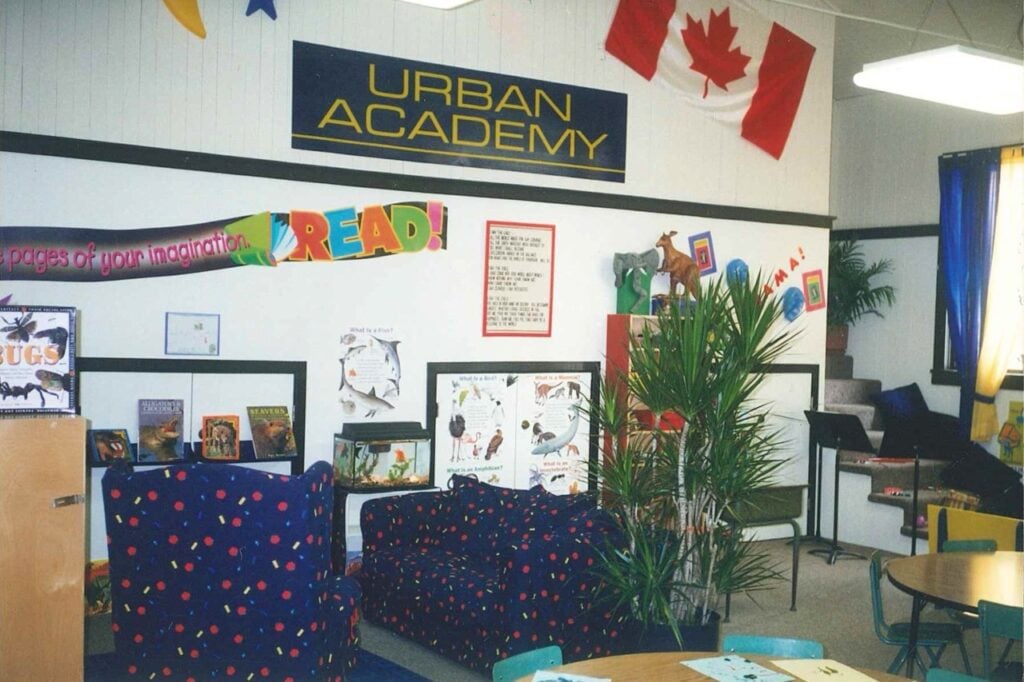
So the Drummonds, Tays Clarkes, and one other family, the Prahsts, set out with an idea. The initial plan was simple, almost comically so. “We just thought, ‘all we need is a teacher and a space, don’t we?’” Donna laughed. “It was like, let’s paint the chalkboards and put up a school.” They discovered that a building where they could legally start a school without too much red tape would be a church. Thus, Urban Academy was born in a rented space at Knox Presbyterian Church.
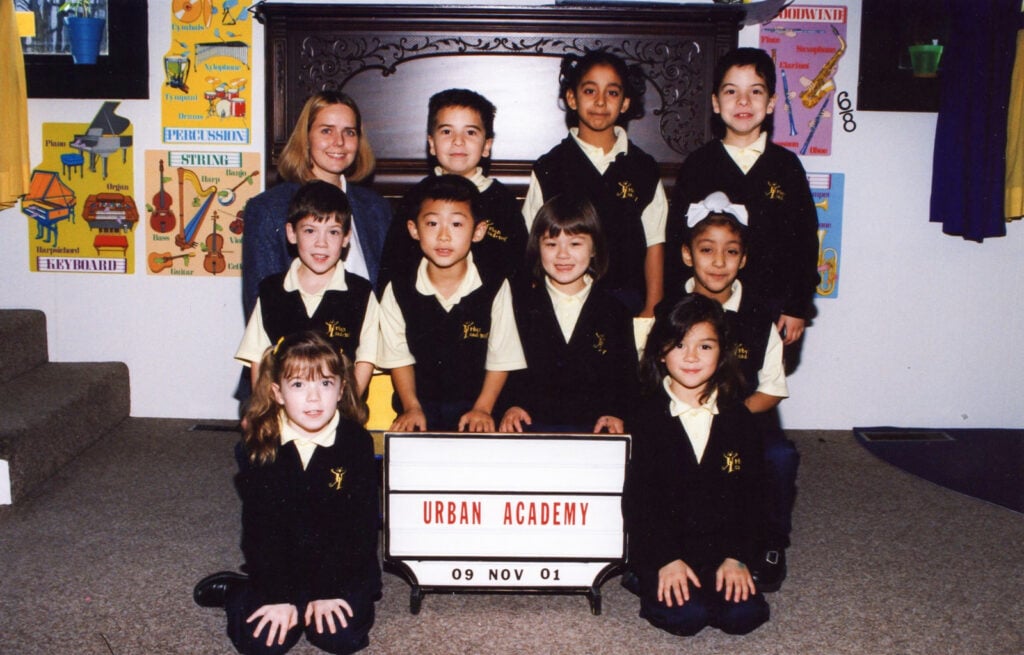
After leasing the space, they still needed a teacher. They held open houses to attract students, speaking with confidence that the right teacher would come. As one did in 2001, they put an ad in the paper and found their first teacher from Calgary. She wasn’t the only one to see that ad. Retired principal June Harrison was also intrigued by a new school in the neighbourhood and picked up the phone. Laura shared, “We had some meetings with June, and I think she just kind of got reinvigorated about school and the process of teaching. She came on board, adding credibility to what we were doing.” So, it began in one rented room with a teacher, a mentor in Ms. Harrison, some freshly painted chalkboards, and ten students by the end of that first September.
The early years were a mix of backbreaking labour and joyful chaos. Donna described it as “all of that kind of messiness… it was the authentic human bond that we needed; the glue to keep enough people together.” The founders served as janitors, lunch supervisors, and maintenance crew. Laura recounted a vivid memory. “One of us would have to show up at lunchtime and take the kids across to the park so that the teacher could have a lunch break,” adding wide-eyed,“ we would bring equipment to clear needles from the park before the kids could play.”
The name itself, Urban Academy, was a compromise from their initial idea of ‘Urban Renaissance Academy,’ which they thought was ‘too flighty.’ However, Brian noted that the spirit of the Renaissance through the UA program lives on.
One of the most significant challenges was accreditation and funding. After being in operation for a full school year without government funding and pouring in their own money to keep the school afloat, they finally received their first check in January 2003. The funds came a full 18 months after opening the doors to Urban Academy. However, it was even more than 18 months prior that the founders had been investing in personnel, equipment and leases. This was an incredible struggle for them that they raised with the Ministry inspectors. Those inspectors were so impressed by their commitment, but realized the funding system in its current form and timing was unsustainable for new schools. The founders’ fiscal responsibility and compelling initiative helped change the provincial funding system to provide earlier payments for future startup schools. This is a fact they are very proud of and has since allowed for countless start-up schools to experience success.
Facing growing pains from sharing space in a rented church, they planned for expansion. In 2006, they purchased Robson Manor in Queens Park. The historic building, which had previously been an event venue, was financed through a Parent Equity Program where early families took a risk to help UA grow, along with support from a generous lender. Donna recalled, “We cleaned, fixed things, assembled furniture, built the playground, we just did everything.” She spent so much time in the beautiful historic gardens that people would mistake her for a hired staff member. Donna and Brian were all in, “We were the funders, the work crew, the staff when necessary. It was us, just doing what needed to be done.”
Because of their deep involvement, Brian and Laura moved a number of times to be closer to the school. Brian remembered, “The number of times the alarm would go off in the middle of the night, and I would show up with a baseball bat, wandering the dark halls of the manor. It was constant.” Donna’s career in real estate and the Drummonds’ careers as actors allowed them to be flexible with their time. They were also fully invested and ensured that the arts were a core component of the school from the start. Laura explained, “Confidence, creativity and community were such a big part of it, the emotional aspect of what we did. We wanted our kids to be able to go out into the world and feel confident enough to do anything they chose.” To this day, the arts remain a valued component of the UA education, only enhanced by the growth in athletics, STEM, and extracurriculars—a true Renaissance education.
The adventure continued as UA was often approached by international agents. It was clear that enrolling International Students would help further grow the school in those early years. But again, with a personal effort by the founders, both the Drummonds and the Tays Clarkes took on hosting international students, up to three at a time each, in order to make it work. For the Drummonds, that meant 6 kids getting ready in the morning. At Knox, they could all walk to school, but Brian still did the morning pick up in their van for other students who needed to get to school. Donna, who innately thrives in building relationships, shared that “We still keep in touch with all of the students we have had. I’ve met them and some of their families, it’s really wonderful to keep that going.”
It turned out that the heaviest part of the load was not filling spaces and teachers, or even welcoming international students into their homes, but rather the administration of a school. With an open mind and desire to learn themselves, they undertook what some may have viewed as the impossible. Starting up a school from scratch included meeting significant Ministry of Education requirements, developing systems for student files, creating handbooks, building an admissions department, while also meeting non-profit status requirements with a board and all that that entails. To stay deeply rooted in community, they also ensured there were opportunities for families to connect. They started a beloved Mother’s Day Tea tradition and the Back To School BBQ, an event that still takes place today, but instead of Brian and Glen flipping burgers, we now have food trucks! For the founding families, it turned out that handing out pencils and welcoming students, while important, was only part of the work.
The project came at a price. Laura reflected, “Now, when we look back on that time of our lives, I don’t know how we did it. There were so many meetings, we were staying up to two in the morning doing paperwork, like it was insane, there were a lot of babysitters.” Still, she affirmed, “As crazy as the first couple of years were, it was still so very fun and very rewarding because of the people we met along the way and the success the school was experiencing.”
So now, looking at today, what are their thoughts about what the school is now? They were asked about Urban Academy’s current mission—connected through learning, inspired by community, empowered to contribute—and its core values. Before even being able to finish that last and oh so important value of the entrepreneurial spirit, the founders beamed. Brian leaned back in his chair, put his hands on his head, smiling, “You know, you could have put those words in front of us 25 years ago, and we would have chosen exactly the same wording.” Donna nodded, “Yes. Absolutely, that feels so right.”
Although the path was challenging and sometimes rocky, there are tendrils, likely more than tendrils, powerful chains anchoring our community of today into the purpose and reason Urban Academy started all those years ago in the hearts of our founders.
While it was a true but heavy labour of love, there are so many people today who are grateful for their vision, passion and personal investments they and their families made in those early years. The hard work, the late nights, the messy moments—all of it created a place where kids feel empowered to belong and stretched to become their authentic selves. To the founders, from all of us who have followed and benefited from this place, we say a heartfelt “thank you.”
~ Ms. Sonja Kennedy / Director of Development