


At Urban Academy, bridging disciplines to create unique learning experiences is what we do. Chemistry 12 and Art Studio 12 students came together for an unforgettable exploration of raku pottery—a fusion of Japanese tradition and American innovation that blends ceramic artistry with chemical reactions.
The Art and Science of Raku Pottery
Raku pottery is a Japanese-inspired American method of firing and quickly cooling metal-glazed ceramics. The history of Japanese raku (named for Zen Buddhists in the Sen no Rikyu family) dates back several hundred years in Japan, and involves a method involving quick cooling of glazed tea bowls. Modern American potters in the mid-1900s developed their own quick-cool methods that involved firing glazed pieces to a high temperature (1800F), allowing a combustion reaction to occur when the pieces are removed from a kiln and quickly quenching this reaction in a metal can. The resulting pieces are iridescent, flashy, metallic pieces that are unique, unpredictable and stunning.
Understanding the Chemistry
Chemistry 12 students explored reduction-oxidation reactions and how the electrons lost in oxidation reactions are the ones gained in paired reduction reactions. Redox reactions are found in numerous real-world applications from batteries, to corrosion, to cathodic protection, to electrolysis. Raku is yet one other connection students could draw between theory in the course into the real world – and a memorable one at that!
In class, we had the opportunity to discuss the reduction reaction that would occur in the copper glaze as copper ions gain electrons (Cu+ + e– → Cu) to form copper metal as well as the oxidation reaction from the newspaper electron source (C + 2 O2- → CO2 + 4e–) that would allow the reduction to proceed. They were able to balance the overall reaction that would take place in copper-glazed pieces.
Creating Pottery in the Art Studio
In the Art Studio, the students took part in pottery making and glazing under our Senior Art teacher Ms. McEwen’s guidance (a welcome and mindful break from balancing redox reactions). The students learned about techniques for building pinch pots and attaching any components as well as methods for glazing.
The Firing Process at Shadbolt Centre for the Arts
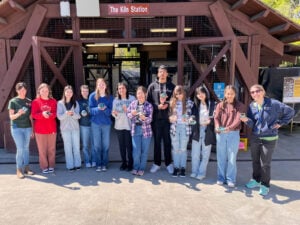
Once pieces were dried, glazed, and ready for firing, the class headed as a group to the Shadbolt Centre for the Arts, where an expert potter, Tony, helped the students heat their pieces in the raku kiln, set up combustion reactions in paint cans, quench the reactions, and cool the pieces in water. The process was fiery and the results were beautiful!


Bridging Theory and Practice
Through raku pottery, Urban Academy students discovered connections between theoretical concepts and tangible outcomes. They celebrated the fusion of artistry and science, leaving a lasting impression on both their educational experience.